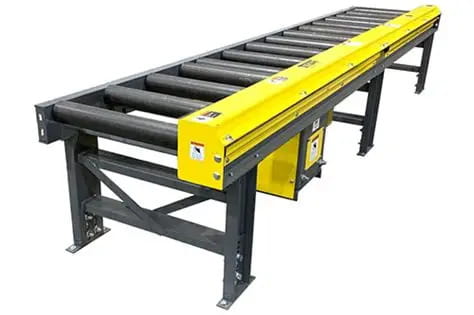
Airoll conveyor rollers are used in material handling and conveyor systems for supporting and transporting loads across industrial applications. The Airoll range includes rollers for unit handling, bulk handling, gravity conveyors, fixed-drive systems and curve conveyors.
We supply Airoll conveyor rollers for different conveyor configurations, load requirements and operating conditions. Available designs include gravity rollers, fixed-drive rollers and other application-specific roller systems.
The suitable roller depends on factors such as load, roller diameter, shaft diameter, roller length, bearing arrangement, roller spacing, conveyor speed and operating environment.
ENGINEERED FOR PERFORMANCE
Request For Quote
NEED A CUSTOM QUOTE?
Get the Right Price for Your
Conveyor Roller
Share Your Conveyor Roller Requirements With Us and Get the Best Price, Tailored to Your Needs. Our Team Will Respond Quickly With a Competitive Quote.
Convero Solutions Conveyor Roller Range
Convero Solutions offers a range of conveyor idlers and rollers designed for different conveyor configurations and material-handling requirements. The company states that its idlers are suitable for conveying lightweight to heavy-duty materials and are available in customer-specific sizes.
Technical calculator used to estimate conveyor belt speed from pulley diameter and rotational speed.
Technical Specifications of Airoll Conveyor Rollers
Tube Diameter
40–88.9 mm
Series 300 / Series 200 configurations
Tube Thickness
1.2–4.5 mm
Depending on roller series and diameter
Shaft Diameter
8–25 mm
Series-dependent configurations
Series 300 Load
65–250 kg
According to tube and shaft configuration
Series 200 Load
200–600 kg
According to roller diameter
Roller Materials
MS / SS / PU
Material and finish vary by series
Bearing Type
Ball Bearing
Precision / deep-groove configurations
Shaft Installation
SR / PE / CD / FT / FTFM
Configuration varies by series
How to Select Airoll Conveyor Rollers
Select the roller based on the actual conveyor loading and mechanical arrangement rather than diameter alone.
Load: Determine the total conveyed load and expected load per roller.
Roller diameter: Select according to load, conveyor speed and product contact.
Roller length: Match the conveyor frame width and required product support.
Shaft diameter: Select according to bearing arrangement and loading.
Bearing: Consider load, speed, contamination and operating conditions.
Roller spacing: Ensure the conveyed product is continuously supported.
Conveyor speed: Consider rotational speed and drive arrangement.
Environment: Check for dust, moisture, temperature and corrosive conditions.
Conveyor Roller Load Calculator
Enter values and calculate the estimated roller load.
Applications
Airoll’s rollers are used across different material-handling requirements, including:
Pallet handling
Crate handling
Steel container handling
Box handling
Tyre and rim handling
Automobile parts handling
Engineering parts handling
Bulk material conveying
Industrial conveyor systems
Automated material handling
The Series 200 documentation specifically lists heavy-load applications such as automobile parts, engineering parts, pallets, crates, steel containers, drums and tyres.
Troubleshooting
A quick diagnostic path for common conveyor roller issues.
1
Roller Does Not Rotate Freely
Check bearing condition, shaft alignment, contamination and whether the roller is correctly seated in the conveyor frame.
2
Excessive Roller Vibration
Inspect shaft straightness, bearing condition, roller concentricity and mounting alignment.
3
Premature Bearing Wear
Check the actual roller load, operating environment, contamination and bearing configuration.
4
Roller Surface Wear
Inspect material contact, conveyed load, product impact and operating frequency. For special applications, consider an appropriate roller surface or coating.
5
Shaft Damage
Check shaft diameter, mounting method, frame alignment and loading conditions.
Request For Quote
NEED A CUSTOM QUOTE?
Get the Right Price for Your
Conveyor Roller
Share Your Conveyor Roller Requirements With Us and Get the Best Price, Tailored to Your Needs. Our Team Will Respond Quickly With a Competitive Quote.