- Global Supply | Worldwide Delivery

Technical reference data covering conveyor roller construction, dimensions, shaft design, bearing systems, load capacity, rotational speed, materials, surface finish and operating conditions.
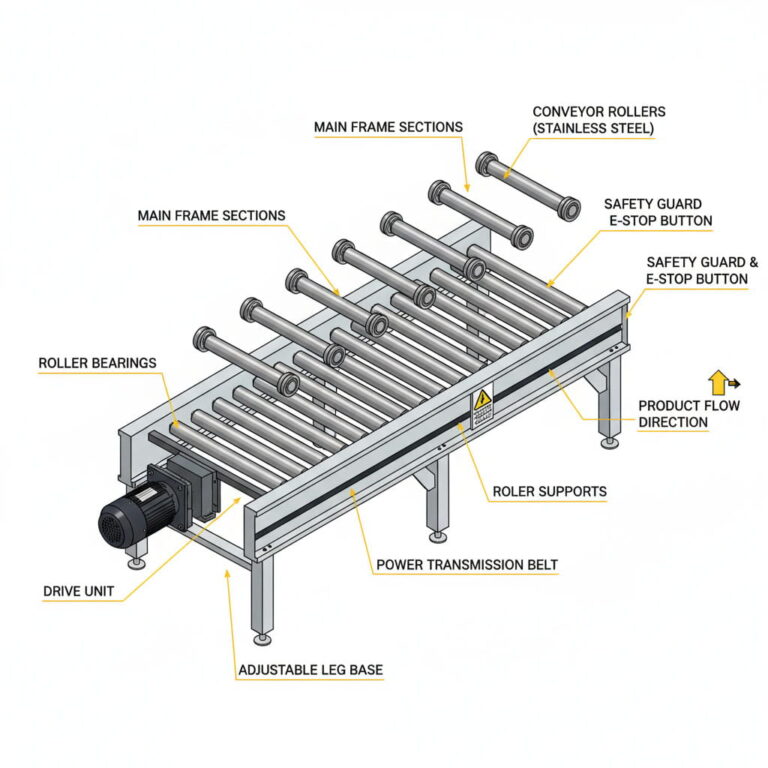
A conveyor roller assembly consists of a cylindrical shell, shaft, bearings, seals and end components designed to provide controlled belt or material movement.
| Component | Typical Material | Typical Specification | Engineering Function |
|---|---|---|---|
| Roller Shell | Carbon Steel / Stainless Steel | Ø60–Ø219 mm typical | Supports belt/load |
| Shaft | Carbon / Alloy Steel | Ø12–Ø40 mm typical | Carries radial and axial loads |
| Bearing | Chrome Bearing Steel | 6200 / 6300 Series examples | Provides low-friction rotation |
| Seal | NBR / Polymer | Contact / labyrinth type | Protects bearing from contamination |
Common dimensional parameters used during conveyor roller selection and engineering.
| Parameter | Typical Range | Unit | Selection Consideration |
|---|---|---|---|
| Roller Diameter | 60 – 219 | mm | Load, belt speed and material density |
| Shell Thickness | 2 – 8 | mm | Load and shell deflection |
| Shaft Diameter | 12 – 40 | mm | Bearing and shaft loading |
| Roller Face Length | 250 – 2400 | mm | Belt width and conveyor arrangement |
| Shaft Extension | 20 – 100+ | mm | Frame and mounting configuration |
Share Your Conveyor Roller Requirements With Us and Get the Best Price, Tailored to Your Needs. Our Team Will Respond Quickly With a Competitive Quote.
Support the loaded carrying side of the conveyor belt.
Support the return strand of the conveyor belt.
Designed to absorb impact at loading and transfer zones.
Used to assist belt alignment and tracking.
Automatically responds to belt tracking conditions.
Roller diameter influences rotational speed, bearing speed, shell stiffness, load distribution and overall conveyor performance.
| Bearing Type | Deep-groove ball bearing / precision bearing assembly |
| Common Bearing Series | 6200 / 6300 series examples |
| Shaft Material | Carbon steel / alloy steel |
| Shaft Diameter | Typically 12–40 mm |
| Bearing Protection | Labyrinth, contact or multi-stage sealing |
| Lubrication | Factory grease / application-specific lubricant |
Roller capacity must be determined from the combined effect of belt load, idler spacing, material impact, belt tension, roller geometry and bearing rating.
Determine from distributed belt and material load.
Dynamic and static load ratings must be checked.
Check bending, shear and combined loading.
Control shell and shaft deflection under design load.
Roller rotational speed can be estimated from conveyor belt speed and roller diameter.
| Roller Diameter | Belt Speed | Approx. RPM |
|---|---|---|
| 108 mm | 1.5 m/s | ≈ 265 RPM |
| 133 mm | 2.0 m/s | ≈ 287 RPM |
| 159 mm | 2.5 m/s | ≈ 300 RPM |
Used for general industrial conveyor applications where mechanical strength and cost-effective fabrication are required.
Typical Finish: Painted / Powder Coated / GalvanizedSuitable where corrosion resistance, hygiene or aggressive environmental conditions require stainless construction.
Common Grades: SS304 / SS316Applied where additional grip, cushioning, noise reduction or surface protection is required.
Typical Coating: Application Specific| Parameter | Reference Range / Consideration |
|---|---|
| Ambient Temperature | Application dependent; commonly −20°C to +60°C |
| Belt Speed | Application dependent; commonly 0.5–5.0 m/s |
| Environment | Dust, moisture, corrosive atmosphere and wash-down conditions |
| Material Characteristics | Bulk density, lump size, moisture, abrasiveness and temperature |
| Impact Conditions | Consider loading height, lump size and impact-zone arrangement |
Check for abnormal resistance, noise, vibration or irregular rotation.
Inspect for excessive noise, temperature rise, contamination and seal damage.
Check for dents, excessive wear, corrosion and shell deformation.
Verify roller alignment and mounting condition to minimize belt tracking problems.
The roller should be selected from the complete conveyor operating envelope, rather than from diameter alone.
Determine roller face length and frame arrangement.
Determines roller RPM and bearing speed.
Establish distributed and impact loading.
Controls load carried by individual rollers.
Select sealing and material according to conditions.
Select shell, shaft and bearing according to duty.