- Global Supply | Worldwide Delivery

HDPE Rollers are conveyor components made with a high-density polyethylene outer body. They are suitable for applications where low weight, corrosion resistance, moisture resistance, and smooth material handling are important.
Compared with conventional steel rollers, HDPE Rollers are lightweight and offer good resistance to moisture and corrosive environments. Therefore, they can be used in conveyor systems where reducing roller weight and protecting against moisture are important.
HDPE Rollers can be used in different conveyor positions based on the conveyor design and load requirements. For example, Carrying Rollers support the loaded conveyor belt on the carrying side.
In addition, Return Rollers support and guide the empty belt on its return path. For applications that require stainless-steel construction, SS Conveyor Rollers can be used where corrosion resistance and hygienic or washdown conditions are important.
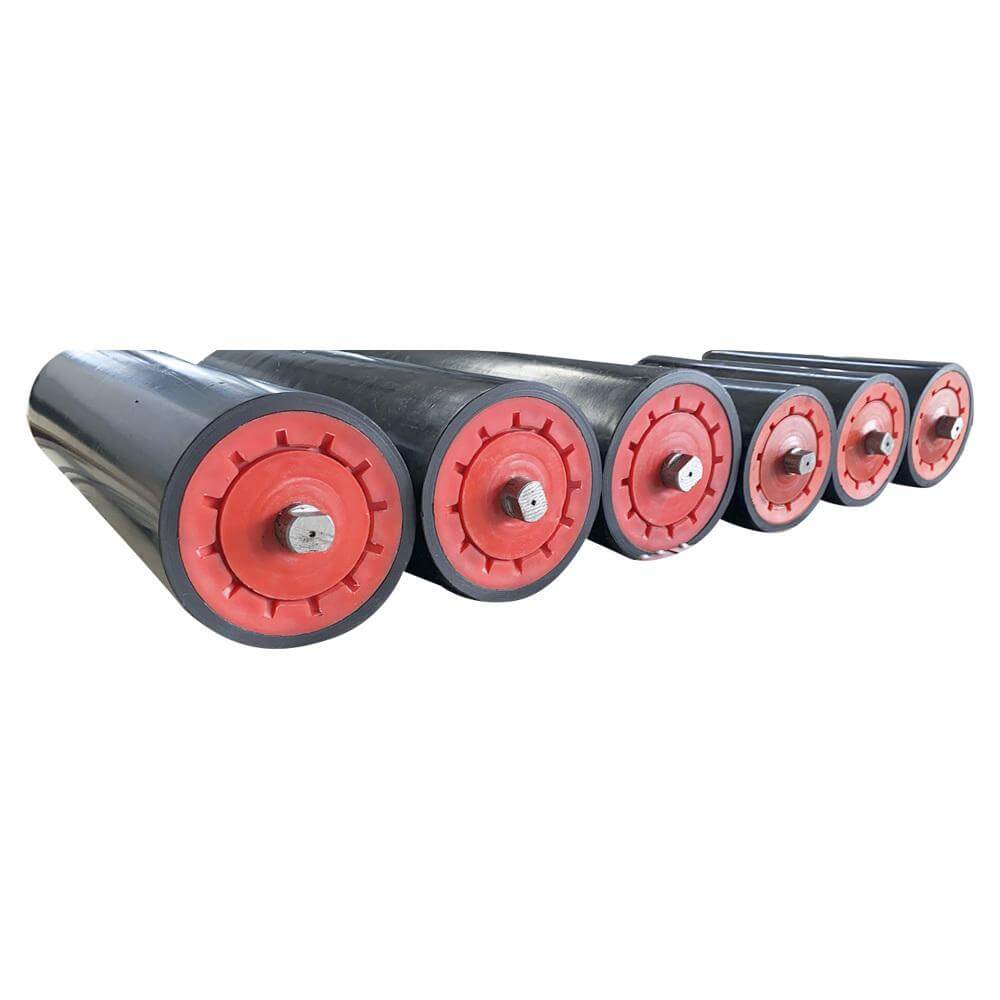
HDPE
Ø89–159 mm
6.4–11.2 mm
Up to 2200 mm
Approximately 40–60%
20–50 mm
6204–6310
0.94–0.97 g/cm³ | 18–31 MPa Yield Stress
Moisture + Corrosion + Chemical Exposure
−40°C to +80°C
Share Your Conveyor Roller Requirements With Us and Get the Best Price, Tailored to Your Needs. Our Team Will Respond Quickly With a Competitive Quote.
Select an HDPE Roller based on belt width, material load, conveyor speed, roller spacing, roller position and operating environment. In addition, the correct roller configuration helps provide stable belt support and smooth, reliable rotation.
Match the roller length to the conveyor belt width. Also, allow enough clearance for the conveyor frame and bearing assembly.
Select the roller diameter based on material load, belt speed and roller spacing. This also helps maintain a suitable rotational speed.
Determine the material load per metre. Then, estimate the load on each roller based on the selected roller spacing.
Choose roller spacing according to belt width and material characteristics. Also, consider the loading condition and required belt support.
Check the belt speed against the roller diameter. This helps determine roller RPM and supports smooth, continuous rotation.
First, identify the required roller position. For example, the roller may be used for carrying, return or another conveyor position.
Match the shaft diameter and bearing arrangement with the conveyor frame. In addition, check the mounting configuration and operating load.
Consider moisture, corrosion, chemicals and temperature before selecting the roller. Also, check the cleaning and washdown conditions.
Belt Width → Roller Diameter → Material Load → Roller Spacing → Belt Speed → Roller Position → Shaft & Bearing → Environment
Estimate the load carried by each conveyor roller using the material load and roller spacing. Use the result as an initial engineering reference when selecting HDPE conveyor rollers.
Estimated load per roller = Material load per metre × Roller spacing. The selected design factor is then applied to provide an additional design allowance.
Click a problem to open its inspection guidance.
Bearing seizure, contamination, shaft misalignment, or excessive loading.
Bearing damage, poor lubrication, or contamination.
Bent shaft, unbalanced roller, worn bearing, or incorrect mounting.
Bearing wear, shaft misalignment, or damaged components.
Excessive load, inadequate lubrication, contamination, incorrect bearing selection, or poor sealing.
Overloading, insufficient shaft diameter, improper mounting, or uneven load distribution.
Find practical technical information about HDPE conveyor roller selection, applications, construction, maintenance and replacement.
An HDPE conveyor roller uses a high-density polyethylene outer body with internal components such as bearings, seals and a shaft. It is designed to support and guide the conveyor belt during material handling.
HDPE rollers are lightweight, corrosion-resistant and suitable for many material handling applications. They can also help reduce material build-up on the roller surface.
HDPE conveyor rollers are commonly used in material handling systems, mining, bulk handling and applications where moisture or corrosion may affect conventional steel rollers.
Start by checking the belt width, roller diameter, material load, roller spacing and conveyor speed. Also consider the roller position, shaft and bearing requirements, and operating environment.
Yes. HDPE rollers can be suitable for wet environments because the HDPE outer body has good resistance to moisture. However, the bearing and sealing arrangement should also be selected for the operating conditions.
HDPE rollers can be considered for applications where corrosion resistance is important. The complete roller design should still be checked for the specific material, moisture level and operating environment.
Yes. HDPE rollers are generally lighter than steel rollers. Therefore, they can be easier to handle during installation, inspection and replacement.
HDPE roller surfaces can help reduce material build-up compared with some conventional roller surfaces. The actual performance depends on the conveyed material and operating conditions.
Bearings are selected based on the roller load, speed, shaft design and operating environment. Sealed bearings are commonly considered where protection from dust and moisture is required.
Check the roller rotation, bearing condition, seals, shaft and outer surface. Also inspect for unusual noise, damage or material build-up. Regular inspection can help identify problems before they affect conveyor operation.
A roller may stop rotating freely because of bearing wear, seal damage, contamination or shaft problems. Check these components and replace damaged parts when required.
Yes. HDPE conveyor rollers can be specified with different roller diameters, lengths, shaft sizes, bearing arrangements and other dimensions to suit the conveyor design.
Provide the roller diameter, face length, shaft diameter, shaft arrangement and bearing details. Also provide the belt width and conveyor application when available.
For a quotation, provide the required roller diameter, length, shaft size, bearing type, quantity and application details. If available, also share the conveyor belt width, material load and operating conditions.