Impact Rollers

Impact Rollers are heavy-duty conveyor rollers designed to absorb impact when bulk material is loaded onto a conveyor belt. They are mainly installed beneath loading and transfer points. These areas experience high shock loads when material falls onto the belt.

In addition, impact rollers help reduce the force transferred to the conveyor belt, idlers, and conveyor structure. As a result, they help protect the belt and support reliable conveyor operation.

Unlike standard carrying rollers, impact rollers typically use rubber discs or impact rings around a steel roller. These flexible components deform under load and help absorb impact energy before it reaches the conveyor structure.

Therefore, impact rollers are particularly useful at high-impact loading points. For example, they are commonly used in mining, quarrying, aggregate handling, cement plants, steel plants, ports, power plants, and other bulk material handling systems.

Moreover, selecting the correct impact roller size and rubber ring configuration can help improve conveyor performance and service life.

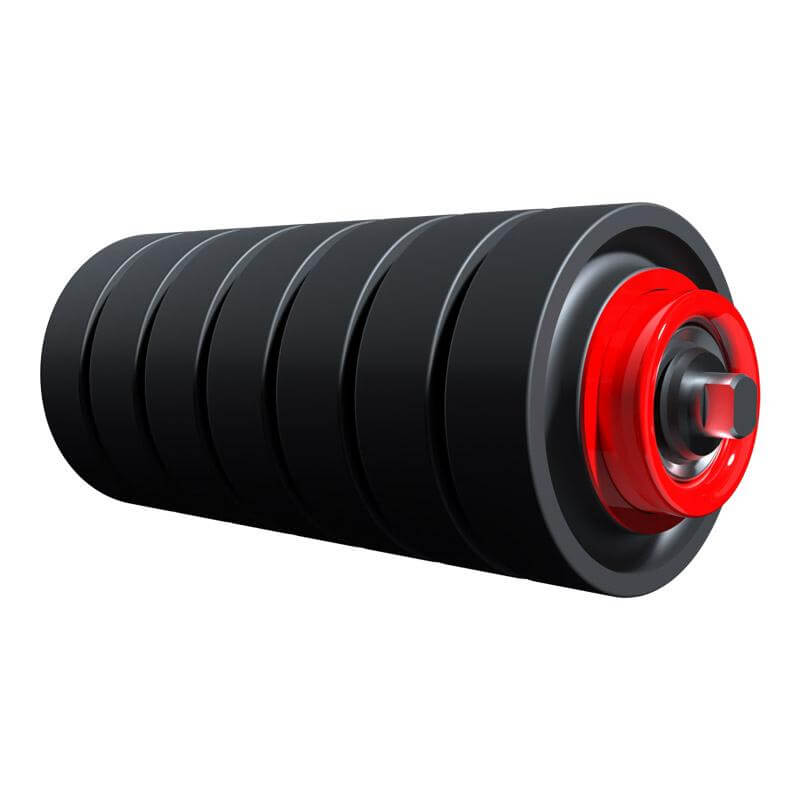
Conveyor Impact Roller idler

Technical Details

Roller Diameter

Ø 50 – 159 mm

Shaft Diameter

20 – 40 mm

Roller Length

300 – 1800 mm

Tube Thickness

2 – 5 mm

Tube Material

MS / SS

Shaft Material

Carbon Steel / Stainless Steel

Troubleshooting

A quick diagnostic path for common conveyor roller issues.
1

Roller does not rotate freely

Inspect bearings, contamination, shaft alignment, seals and excessive loading.
2

Bearing becomes noisy

Check bearing condition, fit, contamination, sealing and operating load.
3

Roller seizure

Inspect the bearing system and identify contamination, overload, misalignment or sealing problems.
4

Uneven wear

Check belt tracking, loading distribution, roller alignment and material buildup.
5

Belt damage near roller

Inspect for seized rollers, damaged tube surfaces, sharp edges and incorrect installation.

Request For Quote

Request For Quote

Conveyor Roller Solutions for Your Requirements


NEED A CUSTOM QUOTE?

Get the Right Price for Your
Conveyor Roller

Share Your Conveyor Roller Requirements With Us and Get the Best Price, Tailored to Your Needs. Our Team Will Respond Quickly With a Competitive Quote.

Impact Roller Calculator

Impact Roller Calculator

Enter your conveyor requirements and click Calculate to view the indicative result.

CALCULATION RESULT0 kg
Load per Roller0 kg
Design Load0 kg
Conveyor Width0 mm
Roller Spacing0 mm
Indicative Selection

Indicative selection aid only. Verify final roller selection against the actual conveyor, material, loading conditions and manufacturer specifications.

Impact Roller Applications

Mining & Quarrying

Loading and transfer points handling bulk materials.

Aggregate Handling

Conveyor systems moving stone, aggregate and similar bulk materials.

Cement & Construction

Bulk-material conveyor systems around material loading areas.

Bulk Material Handling

Loading zones where impact protection is required.

Coal Handling

Bulk conveying systems at suitable loading and transfer points.

Recycling & Processing

Conveyor sections exposed to repeated material loading impacts.

FAQs

What is an impact roller?

An impact roller is a conveyor roller designed for use beneath loading and transfer points where falling material can create higher impact forces on the conveyor belt and idler arrangement.

Where are impact rollers installed?

They are commonly installed beneath conveyor loading and transfer zones where bulk material is loaded onto the belt.

What materials can impact rollers be used with?

Selection depends on the material, particle size, drop height, loading rate, belt characteristics and conveyor design.

Can the roller diameter be customized?

Roller dimensions can be configured according to conveyor design and application requirements, subject to the manufacturer’s available range.

What shaft materials are available?

Common options may include carbon steel and stainless steel, depending on the application and configuration.

How do I select an impact roller?

Consider conveyor width, roller diameter, roller length, shaft dimensions, spacing, material, loading conditions, environment and required load rating.

Does the calculator give a final engineering rating?

No. It provides an indicative load calculation. Final selection should be verified using actual conveyor and operating conditions.

Can impact rollers be used on every conveyor?

Not necessarily. They are generally considered for loading and transfer areas where impact protection is required.

How can impact roller life be maintained?

Keep the loading zone aligned, inspect rollers and bearings, remove buildup and replace damaged or worn components as required.

What information should I provide for an RFQ?

Provide conveyor width, roller dimensions, shaft dimensions, spacing, material, loading conditions, operating environment and required quantity.