- Global Supply | Worldwide Delivery

HIC International is an Indian industrial products company associated with conveyor components, rubber products, power transmission products, and other material-handling equipment.
For conveyor applications, roller selection depends on more than belt width. The conveyed material, loading condition, belt speed, roller diameter, shaft arrangement, bearing selection, dust level, moisture, and conveyor geometry must also be considered. Therefore, a carrying roller used on a normal bulk-material conveyor may not be suitable for an impact zone or a return strand.
HIC International’s roller information includes carrying and self-aligning rollers, impact rollers with rubber rings, and plain or rubber-disc return rollers. In addition, its technical literature specifies ranges for roller diameter, shaft diameter, and belt width.
Share Your Conveyor Roller Requirements With Us and Get the Best Price, Tailored to Your Needs. Our Team Will Respond Quickly With a Competitive Quote.
Conveyor rollers support the belt and the material load while allowing the belt to travel with controlled resistance. Depending on the conveyor section, different roller arrangements are used.
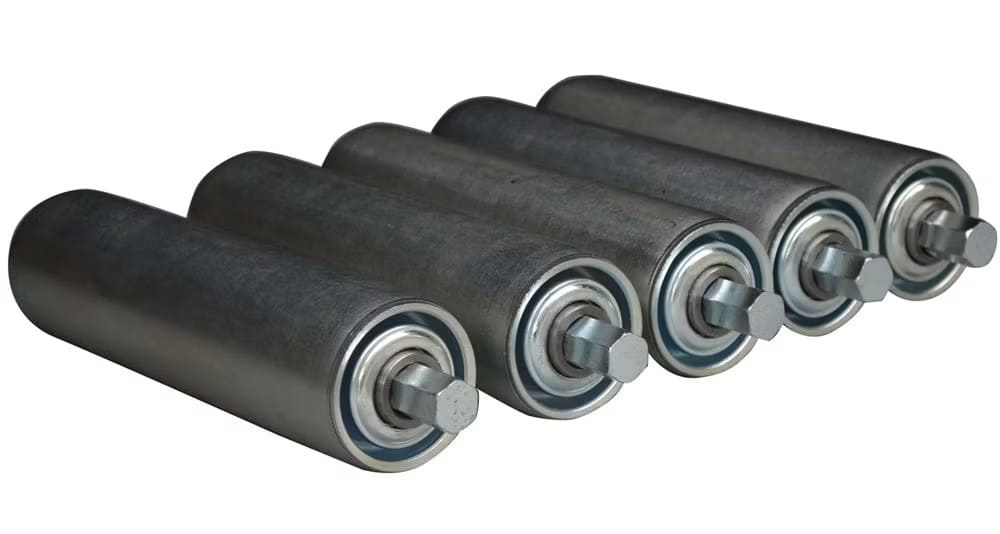
Carrying rollers support the loaded belt on the carrying side. They are commonly arranged in troughing sets so that the belt forms a suitable carrying profile. For example, a Carrying Roller can be selected according to belt width, roller diameter, shaft dimensions, bearing arrangement, and operating conditions.
Return rollers support the empty belt on the return side. Plain return rollers are suitable for many standard applications, while rubber-disc arrangements can help manage material that adheres to the belt. HIC’s published range includes plain and rubber-disc return rollers.
Impact rollers are installed below loading points where falling material creates higher impact forces. Rubber rings are used around the roller shell in the published HIC range. Consequently, impact rollers should be selected according to the loading height, material size, belt speed, and expected impact energy.
Self-aligning or training rollers can be used where belt tracking requires additional support. However, alignment rollers should not be treated as a replacement for correct conveyor alignment. The conveyor structure, pulley alignment, belt condition, and loading pattern should also be checked.
HIC International’s conveyor components are intended for bulk material handling applications where continuous belt movement is required. Its published material identifies applications involving crushers, sand, limestone conveyors, sugar, chemicals, quarry conveyors, tunnel conveyors, mining conveyors, coal washery systems, salt handling, rock handling, power generation, and aggregates.
In a mining conveyor, carrying rollers are subjected to continuous load and abrasive dust. Therefore, sealing and bearing protection become important. Similarly, a crusher conveyor may require impact rollers because large pieces of material can fall directly onto the belt.
For the return side, Return Rollers provide belt support while the belt travels back toward the loading area. Where material carryback is a concern, rubber-disc return arrangements can be considered.
Roller rotational speed is influenced by belt speed and roller diameter. A smaller roller rotates faster than a larger roller at the same belt speed.
The basic relationship is:
RPM = (60 × Belt Speed) / (π × Roller Diameter)
where belt speed is expressed in metres per second and roller diameter is expressed in metres.
For example, if the belt travels at 2 m/s and the roller diameter is 0.114 m:
RPM ≈ (60 × 2) / (π × 0.114)
This gives approximately 335 RPM.
The calculation is useful for understanding rotational speed. However, it does not by itself determine bearing life, load capacity, or complete roller suitability. Those factors require additional conveyor design information.
Choosing the right HIC International conveyor roller depends on the conveyor design, material load, belt width, and operating conditions. Consider these factors before selecting a roller:
HIC International conveyor rollers and idlers are used in a wide range of bulk material handling systems. The roller type is selected according to the material, belt arrangement, loading condition, and conveyor operating environment.
Mining: Conveyor rollers are used to support belts carrying coal, ore, minerals, and other bulk materials. Carrying idlers support the loaded belt, while impact rollers can be installed below transfer points.
Quarrying: Quarry conveyors transport stone, aggregates, and crushed materials. Therefore, rollers should be selected to withstand abrasive dust, continuous operation, and material impact.
Stone Crushing: Crusher conveyors can experience heavy impact when large pieces of stone are transferred onto the belt. Impact rollers with suitable rubber rings can help absorb this loading condition.
Coal Handling: Conveyor systems used for coal handling require rollers that can operate continuously under dusty conditions. Carrying and return rollers support the belt along the conveying circuit.
Cement Plants: Conveyor rollers are used for transporting limestone, clinker, gypsum, coal, and other bulk materials. The roller arrangement depends on the conveyor section and material characteristics.
Power Plants: Bulk material conveyors in power-generation facilities can use carrying, return, and impact rollers for coal and other material-handling applications.
Aggregate Handling: Aggregate conveyors transport sand, gravel, crushed stone, and similar materials. Because these materials can be abrasive, roller construction and bearing protection should be considered carefully.
Salt Handling: Salt conveyors require components that can operate reliably under continuous material-handling conditions. The surrounding moisture and corrosion environment should also be evaluated.
Sugar Industry: Conveyor systems are used for moving bulk materials and process materials within sugar plants. Roller selection should consider belt width, loading, speed, and the conveyor arrangement.
Chemical Industry: Conveyor rollers can be used in material-handling systems within chemical plants. However, the surrounding chemical environment should be considered when selecting roller materials and protective components.
Tunnel Conveyors: Tunnel conveyor systems may operate for long periods with limited access for maintenance. Therefore, roller reliability, sealing, alignment, and accessibility should be considered during system design.
Coal Washery: Conveyor rollers are used for transporting coal and related bulk materials through washing and handling processes. Carrying and return rollers are selected according to the belt and conveyor configuration.
A roller may stop because of bearing damage, dust, or material build-up. First, stop the conveyor safely and inspect the roller. Then, check the bearing and remove any material around the roller. If the bearing is damaged, replace the roller.
Unusual grinding or clicking can indicate bearing wear. Therefore, inspect the noisy roller and compare it with nearby rollers. If the noise continues, the roller should be replaced.
Incorrect roller alignment can cause belt tracking problems. However, pulley alignment and material loading should also be checked. Align the affected roller and inspect the conveyor structure before making further adjustments.
Abrasive material or trapped material can increase roller wear. Check the roller surface and clean any build-up. If the shell is badly worn, replace the roller and inspect the operating area.
Impact rollers can be damaged by heavy material loading or excessive impact. Check the rubber rings and transfer point. If damage is repeated, review the material drop height and loading condition.
Share Your Conveyor Roller Requirements With Us and Get the Best Price, Tailored to Your Needs. Our Team Will Respond Quickly With a Competitive Quote.
HIC International Co Inc is an Indian industrial products company formed in 1988. Its published product information covers conveyor components, rubber products, power transmission products, hydraulic products, and related industrial items.
HIC roller literature covers carrying and self-aligning rollers, impact rollers with rubber rings, and plain or rubber-disc return rollers.
Carrying/self-aligning range includes 89 to 195 mm sizes, while the return roller range includes 76 to 152 mm sizes. Impact roller sizes are separately specified in the published technical literature.
HIC’s published roller literature specifically identifies mining, coal washery, quarry, crusher, aggregate, and other bulk-material applications. Actual suitability, however, depends on the conveyor load, belt width, speed, material, impact conditions, and installation.
Useful information includes roller diameter, roller length, bearing size, quantity, belt width, roller type, shaft dimensions, and a drawing where required. HIC’s published RFQ information also requests these details.
Common causes include bearing wear, contamination, excessive load, misalignment, material build-up, impact loading, damaged seals, and incorrect installation. Therefore, the operating condition should be investigated whenever repeated failures occur.